

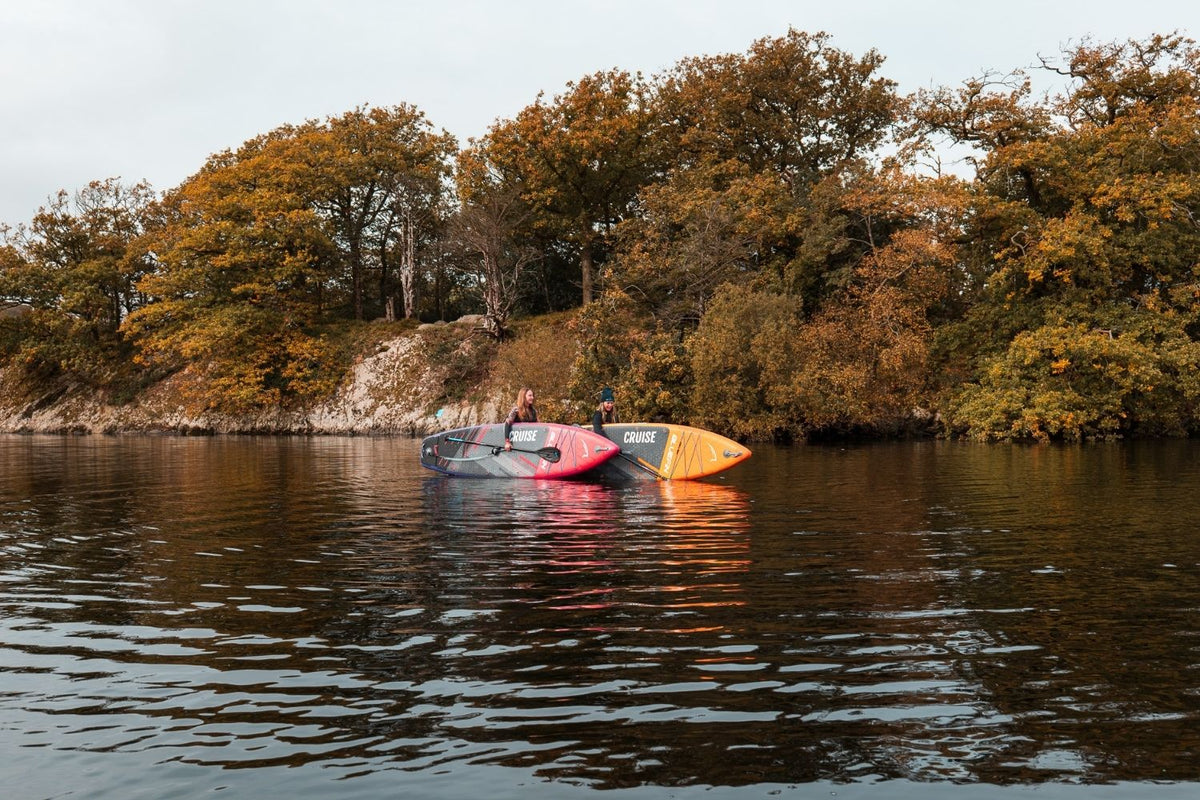
Summer holidays might be ending, but your paddleboarding season does not have to end with them. From German lakes and Dutch waterways to Alpine foothills, Scandinavian archipelagos and Mediterranean coastlines, autumn paddleboarding in Europe can offer quieter water and a completely different atmosphere from peak summer.
The difficulty for most working paddlers is not finding somewhere to paddle. It is finding the time. Shorter days, changing temperatures and less predictable weather mean the relaxed summer approach of "we'll paddle after work" becomes harder to maintain. The solution is not to force summer habits into autumn. Build a different routine for a different season.
When paddleboarding fits naturally around your work schedule, local water and available daylight, staying consistent becomes much easier.

Autumn Paddleboarding in Europe Works Best With Flexibility
Europe does not experience one uniform autumn. A paddler near Hamburg might be dealing with cool, windy conditions while someone on the Mediterranean is still paddling in comfortable sunshine. Alpine lakes can behave very differently from lowland waterways, and coastal destinations introduce tides, currents and sea conditions that may be absent on inland water. That is why a fixed seasonal rule rarely works across Europe.
Your routine should respond to three things:
Your local water.
Your working schedule.
The conditions on the day.
The aim is not to paddle for a predetermined number of hours each week. It is to create enough opportunities that you can take advantage of suitable conditions when they appear.
Use Short Sessions to Keep SUP in Your Working Week
When you work full-time, the biggest obstacle is often the assumption that a paddle needs to become a complete half-day activity. It does not. A short session on familiar water can be extremely worthwhile.
You could build your week around:
A 30-minute paddle before work
A quick SUP fitness session at lunchtime
A 45-minute evening paddle close to home
One longer Saturday or Sunday excursion
One flexible backup window if weather cancels your first plan
Reducing the minimum length of a "proper" paddle makes consistency much easier. You are more likely to get onto the water three times in a week if two sessions require only an hour door-to-door than if every paddle involves travelling to a destination lake.
Turn Your Local Water Into Your Weekday Training Ground
Europe is full of spectacular SUP destinations, but weekday paddling does not need spectacular scenery. Convenience matters more. A nearby lake, suitable river section or sheltered urban waterway may become far more useful during autumn than a famous destination two hours away.
Create a Weekday Radius
Look at locations within roughly 15–30 minutes of home or work.
You are looking for places where you understand:
Access and launch points
Local rules
Parking or public transport
Wind exposure
Exit points
Typical boat traffic
Water characteristics
Familiarity saves time and reduces uncertainty. Save exploration for weekends. Use familiar water to maintain the habit during the week.

Autumn Paddleboarding in Germany: Make Local Lakes Work Harder
Germany is particularly well suited to this style of routine because many paddlers live within reach of lakes, rivers or managed recreational waterways. From Brandenburg and Mecklenburg's extensive lake landscapes to Bavarian lakes, the Ruhr area's reservoirs and waters around Berlin, SUP can often fit around everyday life rather than requiring a dedicated holiday.
But convenient access should never be mistaken for unrestricted access. Local paddling rules vary by waterway, conservation area and navigation zone. The German Life Saving Association, DLRG, specifically advises paddlers to check where SUP is permitted, understand local navigation rules and identify entry and exit points before setting off. Certain reed beds, protected areas, shipping channels and lock systems require particular care or may be off-limits. For working paddlers, this is another reason to establish a small selection of trusted local routes instead of improvising each evening.
Start the Week by Finding Your Weather Window
Rather than choosing a fixed "SUP Wednesday", make your routine conditional. On Sunday evening or Monday morning, look at the week ahead.
Consider:
Wind speed and direction
Rain and thunderstorms
Air temperature
Water temperature
Available daylight
Local water conditions
Any coastal tide or current considerations
Your work commitments
Select two or three possible paddle windows. Then choose the best one as the week develops. This is far more practical than forcing yourself to paddle on the one evening you originally chose, even when conditions have deteriorated.
The DLRG similarly recommends monitoring wind, weather warnings, temperature and changing conditions throughout a trip rather than relying solely on the forecast you checked before leaving home.
Try Paddleboarding Before Work
Evening paddling becomes progressively harder as daylight reduces, particularly across northern and central Europe. That makes early mornings worth considering.
A pre-work paddle can work well if:
Your local launch is close.
Your equipment is prepared the night before.
You know the route well.
Conditions are suitable.
Your working day has a predictable start time.
Pack your work clothes, breakfast and SUP equipment beforehand. Then make the session deliberately short. The goal is not to complete a major route before your first meeting. It is simply to create 30–45 minutes of meaningful outdoor time before sitting at a desk. For home workers, the logistics can be even simpler.
Use Weekends for Distance and Exploration
Your weekday routine should minimise logistics. Your weekend paddle can do the opposite. Autumn weekends are ideal for making more of the hours available before evening.
That might mean:
Driving to a larger lake
Exploring a new section of river
Visiting a sheltered coastal area
Combining SUP with hiking
Taking a paddleboard on a camping trip
Meeting other paddlers
Working on longer-distance fitness
If you enjoy seeing how other people integrate paddleboarding into everyday life, Bluefin's ambassador community includes paddlers combining SUP with jobs, families and other outdoor pursuits across different environments. You can also explore Bluefin's wider Behind the Brand community, which connects owners, ambassadors and paddlers sharing routes and experiences.

Dress for Autumn Water Rather Than Autumn Sunshine
One of the most dangerous assumptions during transitional seasons is judging conditions entirely by air temperature. Warm sunshine can make a launch area feel comfortable even when an unexpected swim would be far less pleasant. Plan clothing around both air and water temperature.
The DLRG advises paddlers to consider whichever is colder the air or water when choosing clothing. It also recommends carrying dry spare clothing in waterproof storage and using suitable water footwear where appropriate. Depending on local conditions, this might involve neoprene layers, a wetsuit, a drysuit or other technical paddling clothing.
Your clothing system should change gradually with the season rather than suddenly switching from summer equipment to winter equipment.
Autumn SUP Safety Becomes Part of the Routine
Safety preparation should not be treated as something reserved for large expeditions. It matters just as much on the lake 15 minutes from home.
Before each session:
Tell someone where you are paddling.
Check your board, paddle and leash.
Carry a phone or reliable means of communication.
Wear an appropriate buoyancy aid or PFD.
Understand local rules.
Use the appropriate leash for the paddling environment.
Check wind and weather.
Give yourself enough daylight to return comfortably.
DLRG guidance also recommends carrying visibility and signalling equipment such as a light, whistle and mobile phone, particularly where paddlers could be difficult for other water users to see. Short paddles still deserve proper preparation.
Product Focus: Choosing a SUP for a Busy Autumn Routine
When paddleboarding needs to fit around work, transport and limited daylight, board choice influences how often you actually go.
Routine |
Priority |
Bluefin Option |
Short recreational sessions |
Stability and easy handling |
Cruise |
Train, apartment or small-car transport |
Compact packing and portability |
Lite |
Longer fitness paddles |
Rigidity and efficient paddling |
Carbon |
Mixed weekend and weekday use |
Versatility |
Cruise |
The Bluefin Cruise is an all-round board designed to combine stability, responsiveness and practical versatility. That can make it a useful one-board option when weekday fitness, relaxed weekend paddles and occasional longer outings all form part of your routine.
For City-to-Water Routines: Lite
If the difficult part of your session is getting the board downstairs, onto public transport or from the office to the water, reducing the transport burden can make a major difference. The Bluefin Lite focuses on lightweight, compact transport and beginner-friendly stability. Its smaller packed format is particularly relevant for people dealing with apartment storage, train travel or longer walks to launch points.
For Longer Training Sessions: Carbon
If paddleboarding forms part of your weekly fitness routine and you regularly cover longer distances, a more performance-orientated board may make sense. The Bluefin Carbon uses carbon-reinforced rails and a dual-chamber construction intended to increase rigidity and control. The best option depends less on what looks impressive and more on which board removes obstacles from your normal paddling routine.
A Practical Monday-to-Sunday Autumn SUP Routine
A full working week does not need to compete with paddleboarding.
Try this adaptable structure instead.
Monday: Plan, Don't Paddle
Check the weather for the week and identify two potential short-session windows plus one weekend opportunity. Prepare any equipment that needs drying, cleaning or charging.
Tuesday: 30–45 Minute Local Paddle
Choose familiar water close to home. Keep intensity moderate and use the session as a reset after work.
Wednesday: Strength or Mobility
Spend 20–30 minutes working on your legs, core, shoulders and mobility. This supports paddling while giving you a useful alternative when daylight or weather is poor.
Thursday: Second Paddle Window
If Tuesday was cancelled, Thursday becomes the replacement. If Tuesday went ahead and conditions remain good, use Thursday for a slightly more purposeful fitness paddle.
Friday: Prepare Your Weekend Kit
Check your board, paddle and safety equipment. Pack everything before the weekend rather than starting from scratch on Saturday morning.
Saturday or Sunday: Longer Adventure
Choose whichever day offers the most suitable conditions. Increase your distance, explore somewhere new or paddle socially. The result is a routine with two realistic opportunities during the working week and one higher-value weekend session, without needing SUP to dominate your calendar.
Common Mistakes When Balancing SUP and Work
Planning Sessions That Are Too Long
If every paddle needs two or three free hours, work will win surprisingly often. Set a lower minimum. A short paddle still counts.
Travelling Too Far on Weekdays
Destination paddles are exciting but they carry a high logistical cost. Find a local route you are happy to repeat.
Leaving Equipment Scattered Around the House
Create one storage area for SUP kit. The fewer things you need to find before leaving, the more likely you are to follow through.
Treating Bad Weather as Lost Training
Wind or storms might stop your paddle, but they do not have to stop your routine. Walk, run, strength train or work on mobility instead.
Staying Out Because Your Calendar Says You Should
No working-week goal is worth ignoring deteriorating conditions. The water has the final say.
Look After the Board You Already Own
A routine based on regular paddling gives your equipment a demanding life. Boards are inflated, packed, carried, exposed to wet ground and repeatedly transported throughout the season. That makes durability and maintenance important. Rinse equipment where necessary, allow it to dry properly, check your fin and valve areas and inspect the board periodically.
Looking after equipment you already own is one of the simplest ways to reduce unnecessary replacement.
Summary: Make Paddleboarding Part of Autumn, Not a Summer Memory
The most effective autumn paddleboarding in Europe routine is not the one with the biggest mileage target. It is the one you can actually maintain. For most working paddlers, that means reducing travel during the week, keeping equipment organised and becoming much more selective about weather and daylight.
Think in terms of small windows rather than entire free days. Thirty minutes before work matters. Forty-five minutes on your local lake matters. A calm Sunday morning paddle matters. Put those sessions together across September, October and beyond and you may spend far more time on the water than someone waiting for the next perfect weekend. Autumn does not need to end your paddleboarding routine. It simply asks you to paddle differently.
Keep Your Autumn SUP Routine Simple
Choose the board and routine that make it easier to turn an ordinary working week into more time outdoors, from quick local lake sessions to longer weekend adventures.
Aktie:
Quiet Paddleboarding Destinations Europe: Where to SUP After Peak Season