

Table Of Contents
Few places offer paddleboarders as much variety as Europe.
You can paddle beneath Alpine peaks, explore forest-lined German lakes, cruise Mediterranean bays or take on the colder and more exposed coastlines of the Atlantic, Baltic and North Sea.
That variety makes coastal vs inland paddleboarding in Europe an important choice rather than a simple preference.
Conditions, regulations and access can change significantly between countries — and sometimes between neighbouring lakes or stretches of coastline.
The right question is therefore not simply “Should I paddle at sea or on a lake?”
It is: Which environment best matches my experience, equipment and the conditions today?

Coastal vs Inland Paddleboarding Europe: Quick Comparison
Factor |
Coastal Paddleboarding |
Inland Paddleboarding |
Water movement |
Waves, tides, currents and swell possible |
Still water through to strong river flow |
Wind |
Frequently exposed |
Can be sheltered, but large lakes remain vulnerable |
Beginner suitability |
Excellent in some protected bays |
Often excellent on calm lakes |
Typical route planning |
Weather, landing points and local sea conditions |
Access, navigation, boat traffic and river hazards |
Main hazards |
Offshore wind, waves, tidal flow, rocks |
Weirs, current, boat traffic, locks, submerged obstacles |
Regulations |
Country and local coastal rules |
Country, regional and waterbody rules |
Travel appeal |
Beaches, islands and coastline |
Lakes, rivers, canals and mountain scenery |
Best for |
Coastal touring and exploration |
Learning, leisure, fitness and touring |
A key point for European paddlers is that geography alone tells you very little about difficulty.
A quiet Croatian bay may provide easier paddling than a windswept Alpine lake. A protected Baltic lagoon can be gentler than a major inland river with commercial traffic.
Always judge the specific water.
What Is Coastal Paddleboarding Like in Europe?
European coastal SUP varies enormously.
Mediterranean paddling is often associated with warm weather and clear water. The Atlantic coast can bring swell and rapidly changing conditions. The North Sea and Baltic introduce their own combinations of wind, currents and lower water temperatures.
No single set of conditions defines “European coastal paddling”.
Mediterranean Paddleboarding
Regions of Spain, France, Italy, Croatia and Greece offer extensive opportunities for sheltered coastal SUP.
On settled mornings, protected bays can deliver wonderfully calm water.
That does not make them risk-free.
Local winds can strengthen quickly, while boat traffic, rocky coastlines and limited landing opportunities can complicate routes.
Summer heat also introduces an easily overlooked issue: hydration and sun exposure.
Before a Mediterranean paddle:
Check the local wind forecast.
Identify whether winds strengthen later in the day.
Carry sufficient drinking water.
Use appropriate sun protection.
Understand local beach and navigation zones.
Know where you can safely land.
Starting early can often provide calmer conditions, but local knowledge should take priority over general assumptions.
Atlantic Paddleboarding
Europe's Atlantic coastline can provide spectacular SUP opportunities, but swell has a major influence.
Portugal, western Spain, France and Ireland can experience ocean swell even when local winds are relatively light.
That can create challenging launches, breaking waves and difficult landings.
A paddler who is comfortable on a flat lake should not assume those skills automatically translate to open Atlantic conditions.
Surf, swell and tidal movement require their own experience.
North Sea and Baltic Paddleboarding
Northern European coastlines can combine strong winds, cooler water and rapidly changing weather.
The Baltic is often less affected by ocean swell than exposed Atlantic coastlines, but wind remains important.
The North Sea brings additional tidal considerations in many locations.
Regardless of coastline, offshore wind is a major warning sign for paddleboarders. A lightweight inflatable SUP can be carried away from land more quickly than many beginners expect.
What Is Inland Paddleboarding Like in Europe?
Europe has an enormous range of inland paddling environments.
Think Alpine lakes in Austria and Germany, interconnected waterways around Berlin and Brandenburg, Scandinavian lakes, French rivers, Dutch canals and mountain reservoirs across southern Europe.
For many paddlers, this is where SUP is at its most accessible.
Lake Paddleboarding
Calm lakes provide one of the easiest places to learn basic paddleboarding technique.
You can concentrate on:
Balance
Paddle technique
Turning
Stopping
Board control
Remounting
Building confidence
But not all lakes are small or sheltered.
Large European lakes can develop significant wind-driven waves and chop, particularly where wind has a long distance over which to build.
An Alpine lake that looks perfectly calm at 08:00 can feel very different several hours later.
Local weather patterns matter.
River Paddleboarding
Rivers add current.
Even moderate current influences how quickly you can stop, how you approach corners and what happens when you fall.
Watch carefully for:
Weirs
Bridges
Commercial vessels
Moorings
Trees
Narrow channels
Locks
Strong eddies or changing flow
Moving water deserves specific training and equipment choices.
Never assume river paddling is easier than sea paddling simply because you are inland.
Paddleboarding in Germany: Why Inland Water Is So Popular
Germany is a useful example of how varied inland SUP can be.
From Brandenburg's lakes and waterways to Bavaria's mountain scenery and northern lake districts, paddlers can find everything from calm recreational water to busy navigation routes.
Popular SUP environments include large lakes, interconnected waterways and urban rivers.
German paddlers are still participants in water traffic rather than being exempt from navigation rules. Current German guidance notes that rules such as the inland navigation regulations and collision-prevention rules can apply, while restrictions may exist around locks, protected nature areas, drinking-water zones and other locally controlled waters.
German federal law also allows navigation on federal waterways subject to applicable navigation law, while access can be regulated or restricted in protected areas.
The practical implication is straightforward:
Check the exact Gewässer before you launch.
Regulations can be imposed at federal, state, municipal or local level, and individual lakes may have specific rules.
German SUP Safety Guidance
A 2026 initiative involving organisations including DKV, DLRG, Wasserwacht and VDWS introduced shared SUP safety messaging focused on issues including weather, wind, traffic, currents and environmentally sensitive areas.
For paddlers visiting Germany, that reinforces an important principle:
Treat local rules and local safety information as part of your route planning, not as something to check after arriving.

Are SUP Rules the Same Across the EU?
No.
There is no single practical set of access rules that can be assumed to cover every European lake, river and coastline.
Rules can differ according to:
Country
Region
Municipality
Navigation authority
Harbour authority
Nature reserve
Private ownership
Water supply restrictions
Commercial shipping rules
Seasonal conservation measures
A SUP that can be launched freely on one lake may be restricted on another lake a short drive away.
Germany is a good illustration: general navigation rules exist, yet additional local restrictions can apply to individual waterways and protected areas.
When travelling with your board, check official local information for every new paddling location.
Do not rely solely on social media posts, old travel blogs or the fact that someone else is already on the water.
Which Is Better for European Beginners?
In most cases, calm and sheltered inland water provides the easiest learning environment.
A suitable beginner location should have:
Little or no current.
Easy entry and exit.
Limited boat traffic.
Shelter from strong winds.
Plenty of room.
Confirmed legal access.
A straightforward route back to shore.
A protected coastal bay can also be beginner-friendly when conditions are suitable.
The difference is that coastal paddlers need to develop wind and sea awareness from the start.
If you are travelling, instruction from a reputable local SUP centre can be particularly useful because local instructors understand the conditions and regulations of that specific area.
Still Water vs Moving Water Matters More Than Coast vs Inland
One of the most useful ways to think about SUP environments is still water versus moving water.
Still water generally gives you more time to react.
Moving water changes your position even when you stop paddling.
At sea, movement can come from:
Tides
Swell
Waves
Coastal currents
Wind
Inland, movement can come from:
River current
Wind-driven lake conditions
Locks
Weirs
Dam releases
Commercial vessels
Once you understand this distinction, comparing coastal and inland locations becomes much easier.
Ask what forces are acting on you and your board, rather than simply asking whether you are at the sea or inland.
Wind: The Universal SUP Hazard
Wind affects paddleboarders almost everywhere.
Large inflatable boards have plenty of surface area for the wind to act upon, especially when the paddler is standing.
Before every session, check:
Current wind speed
Direction
Forecast changes
Gust speed
Exposure of the location
Your return direction
On inland lakes, wind can push you towards a distant shore.
At the coast, offshore wind can push you away from land entirely.
If paddling into wind becomes difficult, dropping to your knees reduces your profile and can make progress easier.
Prevention remains better than recovery: choose conditions that suit your experience.
Choosing a SUP for European Coastal and Inland Adventures
A European paddling trip can involve several environments in a single holiday.
You might spend one day on a mountain lake and another beside the coast.
That makes versatility and transportability particularly valuable.
Bluefin Lite: For Easy Transport and Casual Paddling
The Bluefin Lite is a compact, lightweight inflatable SUP designed around easy handling, stability and beginner-friendly use.
Its smaller packed format is particularly useful when:
Travelling by car
Staying in apartments
Carrying equipment to remote lakes
Managing limited storage
Taking a board on multi-stop holidays
For calm recreational paddling and portability, those practical considerations can matter more than outright speed.
Bluefin Cruise: A Versatile European All-Rounder
The Bluefin Cruise is designed as an all-round board combining stability with responsive handling.
That makes it relevant for paddlers wanting one SUP for varied environments such as:
German lakes
French waterways
Dutch canals
Calm Mediterranean beaches
Sheltered coastal bays
Weekend touring
For most recreational paddlers, a versatile board opens more possibilities than an overly specialised design.
Bluefin Carbon: For Progression and Longer Routes
The Bluefin Carbon uses a dual-chamber construction and carbon-reinforced rails designed to increase stiffness, control and performance.
That becomes more relevant if you regularly paddle longer distances or want a more performance-focused setup.
Whatever your board, environmental limits still apply.
A stiffer or faster SUP does not make unsafe weather safe.
Travelling Around Europe With an Inflatable SUP
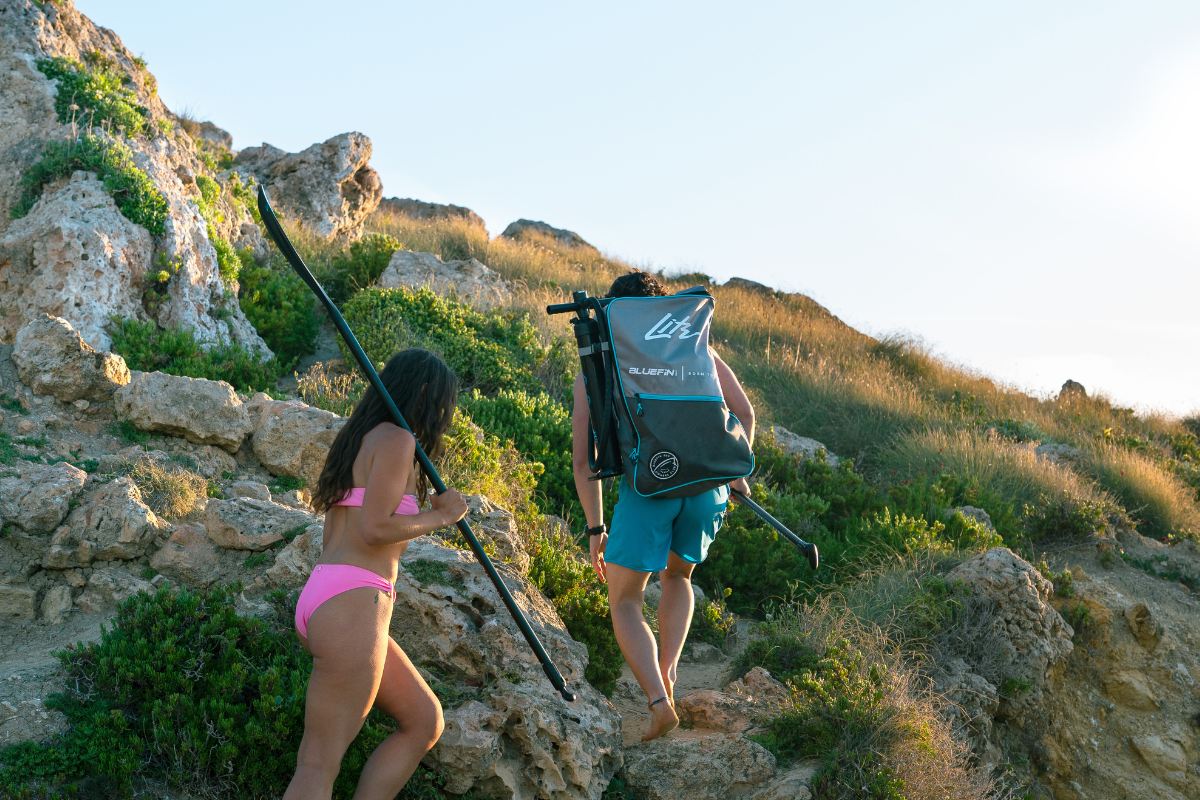
One advantage of inflatable paddleboards is that they can be packed away between destinations.
That makes road trips and multi-location holidays much easier than travelling with a rigid board.
Before leaving:
Check packed dimensions.
Check airline baggage allowances if flying.
Dry your equipment properly before packing it.
Protect the fin and valve areas.
Carry an appropriate repair kit.
Confirm local SUP access before travelling to the launch.
Check whether your accommodation has somewhere suitable for drying equipment.
The Bluefin Lite is particularly focused on compact transport, while the Cruise prioritises broader all-round use.
Choose according to the whole journey, not just the time you spend standing on the water.
Saltwater Paddleboard Care
Paddling in salt water creates some additional maintenance requirements.
After a coastal session:
Rinse the board with fresh water.
Rinse the paddle and leash.
Remove sand from the fin box.
Check attachment points.
Allow equipment to dry.
Store it away from excessive heat and prolonged UV exposure.
These simple habits help protect equipment over repeated coastal trips.
Bluefin's Built to Last approach focuses on durability and extending the usable life of SUP equipment.
That matters whether your board spends most of its time on salt water, freshwater or a mixture of both.
Common European Coastal SUP Mistakes
Assuming the Mediterranean Is Always Calm
Clear blue water can create a false sense of predictability.
Local winds can strengthen rapidly, particularly around islands, headlands and exposed bays.
Check a location-specific marine forecast rather than relying on a general weather app.
Underestimating Atlantic Swell
The absence of strong local wind does not mean the absence of waves.
Swell can originate hundreds of kilometres away.
Paddling Too Far From Landing Options
Some rocky European coastlines have long stretches with few safe places to leave the water.
Know your exits before committing to a route.
Common European Inland SUP Mistakes
Assuming Every Lake Has Open Access
Rules vary.
This is particularly relevant around nature reserves, drinking-water reservoirs and privately managed waters.
Ignoring Commercial Shipping
Major European rivers and canals may carry significant commercial traffic.
Keep clear of navigation channels and understand local rules before entering busy waterways.
Disturbing Sensitive Wildlife Areas
Shallow margins and reed beds are often important habitats.
German paddling guidance, for example, specifically emphasises avoiding sensitive shoreline vegetation and wildlife areas.
The quietest-looking corner of a lake may be precisely the place wildlife needs you to avoid.
Responsible SUP Across Europe
Paddleboarding gives us access to places that are often environmentally sensitive.
Good practice includes:
Giving wildlife space.
Avoiding nesting areas.
Staying out of restricted zones.
Using established launch points.
Taking all rubbish away.
Cleaning equipment before transferring between sensitive waterways where advised.
Keeping noise low around wildlife.
Respecting swimmers, anglers and other water users.
Bluefin's Eco Positive approach reflects a wider commitment to reducing environmental impact and encouraging longer equipment life.
Access to beautiful water comes with responsibility for protecting it.

Coastal or Inland SUP for European Touring?
Both can deliver outstanding touring.
Inland paddling is ideal for exploring connected lake systems, rivers and canals.
Coastal touring can provide greater variety but usually demands more environmental planning.
Before a longer route:
Check the full weather window.
Identify safe exits.
Understand currents or tides.
Carry food and water.
Wear appropriate flotation.
Dress for water temperature.
Carry a means of communication.
Know local regulations.
Leave your route with someone on land.
Keep a conservative turnaround point.
As your paddling progresses, understanding why different shapes and constructions behave differently can also help. Bluefin's Innovate, Educate, Navigate page explains more about its approach to SUP development and education.
Summary: Coastal vs Inland Paddleboarding in Europe
Choose inland water if you want calm conditions for learning, scenic lake touring, casual recreation or easier route planning.
Choose coastal water when you are comfortable assessing wind, waves, currents and changing conditions and want to explore Europe's beaches, bays and coastline.
For most people, the best answer is eventually both.
A versatile inflatable paddleboard gives you the freedom to move between environments, but skill and judgement determine whether the conditions are suitable.
When comparing coastal vs inland paddleboarding Europe, remember that location type is only the beginning.
A calm German lake, protected Croatian bay, windy Alpine reservoir and tidal North Sea beach are four entirely different paddling environments.
Learn to read the individual water, check the local rules and build your experience gradually.
That approach gives you far more freedom to explore Europe safely and confidently.
Find a SUP for European Adventures
Whether your next trip involves a German lake, Mediterranean bay or a weekend exploring local waterways, choose a paddleboard that fits how you actually travel and paddle.
Aktie:
Paddleboarding for Mental Health: Why Water + Sun Matter
10 Bucket List Paddleboarding Locations in UK & Europe